Exam Studio
An exam decides everything about how the assessment behaves: which questions appear, in what order, how long the examinee has, who may sit it, and when the result is released.
The Exam Studio is where you build one. It opens when you create or edit an exam and takes the whole browser window, so nothing of the site or the administrator sits around your work. Questions are written and edited right here, inside the exam — you no longer have to create them in the question bank first.
The screen
| Area | What it is for |
|---|---|
| Top bar | Back to the exam list, the exam title, undo and redo, the issue count, the published state, Exam settings, Preview and Save. |
| Outline (left) | Every question and random draw in order, grouped by section. Drag to reorder, or use the keyboard. |
| Exam (middle) | The exam as a column of cards, each showing the question as it reads. Click a card to edit it in place. |
| Question settings (right) | Points, subject, difficulty, tags, explanation and the other settings of the selected question. |
The side panels are yours to arrange: drag an edge to resize a panel, or fold it away. Your layout is remembered in this browser. On a narrow screen the panels fold on their own.
Saving. One Save button (or Ctrl+S) saves everything — the exam, its structure and every question you changed. A dot marks what is unsaved. If one question cannot be saved, the others still are, the failing one is marked, and the exam's structure is saved only once every question has been.
Undo and redo. Ctrl+Z and Ctrl+Shift+Z step through what you arranged: questions added or removed, order, sections, points, random draws and exam settings. Text you typed has the editor's own undo. Undo does not reach back past a save.
Leaving. The studio warns before you leave with unsaved changes. If the tab is closed or the session expires anyway, the browser keeps your changes and offers to restore them the next time you open the exam.
Two people on one exam. If someone else saved the exam or a question while you were editing it, your save is stopped and you choose: Reload takes their version, Overwrite saves yours over it.
Keyboard
| Key | Does |
|---|---|
| Ctrl+S | Save |
| Ctrl+Z / Ctrl+Shift+Z | Undo / redo |
| Arrow keys in the outline | Move between rows |
| Ctrl+D | Duplicate the selected question |
| Delete | Remove the selected row from the exam |
Adding questions
An exam gets its questions three ways, and can mix all of them.
| New question | From bank | Random draw | |
|---|---|---|---|
| What it is | Written here, inside the exam | An existing question from the question bank | A rule that draws questions at random from the bank |
| Same for everyone | Yes | Yes | No — drawn per attempt |
| Points | Set per question | Set per question | Set per rule, or each drawn question's own |
| Ordering | Explicit, drag to reorder | Explicit, drag to reorder | Drawn, then placed |
New question. Choose a type and write it in the card. It uses the same editor as the question bank, with every question type. Writing questions here needs the questions create and edit permissions; with exam permissions alone you can still pick from the bank, reorder and set points.
From bank. The picker searches the whole bank and filters by subject, type, difficulty and tags. Tick as many as you like across pages and add them in one step. Questions already in the exam are shown but cannot be added twice. Only published, approved questions are listed.
Random draw. A rule names a subject (including the subjects under it), tags and a difficulty, and a number to draw. Each examinee gets a different selection. The studio counts the matching questions as you build the rule, using the same query the real draw uses, and warns when fewer match than you asked for. A question that has a newer version in the bank is never drawn, so a learner cannot get an old answer key and its correction as two questions.
Note: the question count in the exam list counts fixed questions only, so an exam made only of random draws legitimately shows zero there. The studio's outline reports the real total, and shows the total points as a range when a draw uses each question's own points.
The draw happens once. When an examinee starts, the paper is resolved and frozen into the attempt along with the taking mode. Editing the exam or the bank afterwards never changes a paper already in progress. While learners are taking the exam, the studio says so: your changes reach new attempts only.
Keep in bank
Every question written in the studio has a Keep in bank switch.
| Keep in bank | Where the question lives |
|---|---|
| On | In the question bank. Other exams can use it too. |
| Off | Only in this exam. It is not listed in the question bank or the picker, is never drawn by a random rule, and is left out of exports and counts. |
Whether the switch starts on or off for a new question is a site setting — see Settings. A question that other exams already use cannot be made exam-only; make a copy for this exam instead.
An exam-only question is deleted with its exam, or when you remove it from the exam and save. If learners have already answered it, it is kept hidden instead, so their results still open.
Points here
Points here sets what a question is worth in this exam only. It never changes the question's own default points, so the same question can be worth two points in one exam and five in another. Leave it empty to use the question's own.
Questions other exams use
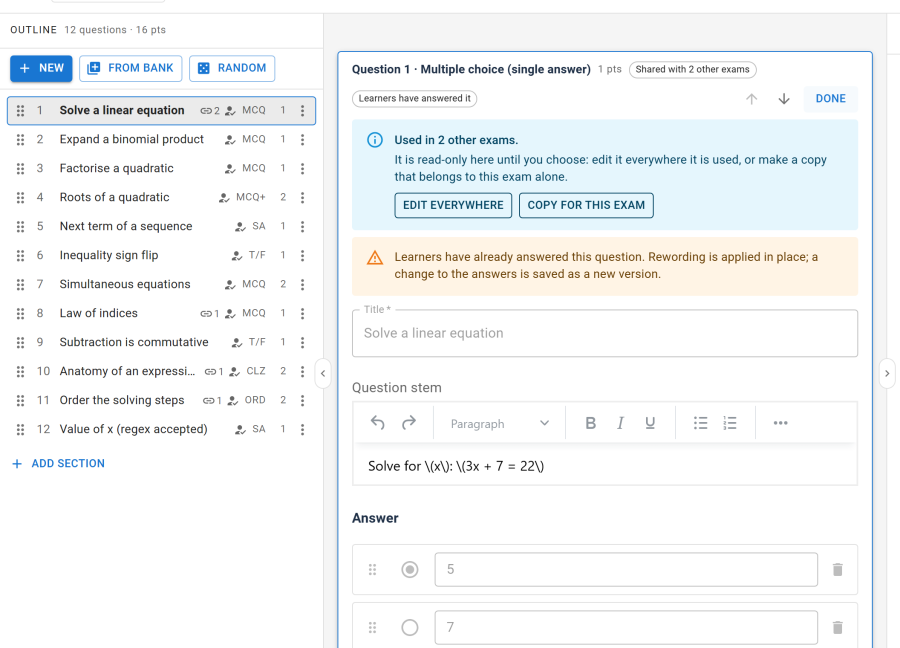
Opening a question that other exams also use shows how many, and keeps it read-only until you choose:
- Edit everywhere — your changes apply in every exam that uses it.
- Copy for this exam — this exam gets its own copy, and the other exams are left untouched.
Questions learners have already answered
Once a learner has answered a question, the studio protects their result.
- Rewording is applied in place. Title, question text, explanation, option text, feedback, subject, tags, difficulty and default points can all be corrected.
- A change that affects the answers becomes a new version. Changing the correct answer, the options, the accepted answers or the order saves a new question that replaces the old one — in this exam always, and in whichever other exams you tick. Past results keep the version that was actually answered, and still open and grade against it.
- The type cannot be changed once a question has been answered.
Checks
The issue count in the top bar lists what would go wrong for learners before it does: a question still in draft or unpublished (learners would not get it), a random draw that cannot be filled, a question in the exam twice, an exam with no title or no questions. Publishing with open issues asks you to confirm first.
Preview
Preview shows the exam on your site's real exam page — the same template, layout overrides and styling learners get — inside the studio. Pressing it saves first, so what you see is what is saved.
- Show the whole exam or only this question.
- Switch between desktop, tablet and phone widths, restart, or open it in a new tab.
- Nothing is recorded. A preview creates no attempt, so it sends no email, fires no webhook, issues no certificate and never appears in results or reports.
- Preview ignores the access gate, the exam window and the cooldown, and shows draft questions that learners would not be served.
The preview link is signed for you and lasts fifteen minutes; the studio renews it when you restart. Pausing, and the per-question check of practice mode, are not available inside a preview. The preview needs the site to be online.
Sections
Questions can be grouped into named sections, each with an optional description and its own points per question. A section lets you build a paper with a recognisable structure — a comprehension section, a calculation section — rather than one flat list. Sections can be moved up and down as a whole, and questions dragged between them.
Sections are presentational and organisational; grading is still per question.
Exam settings
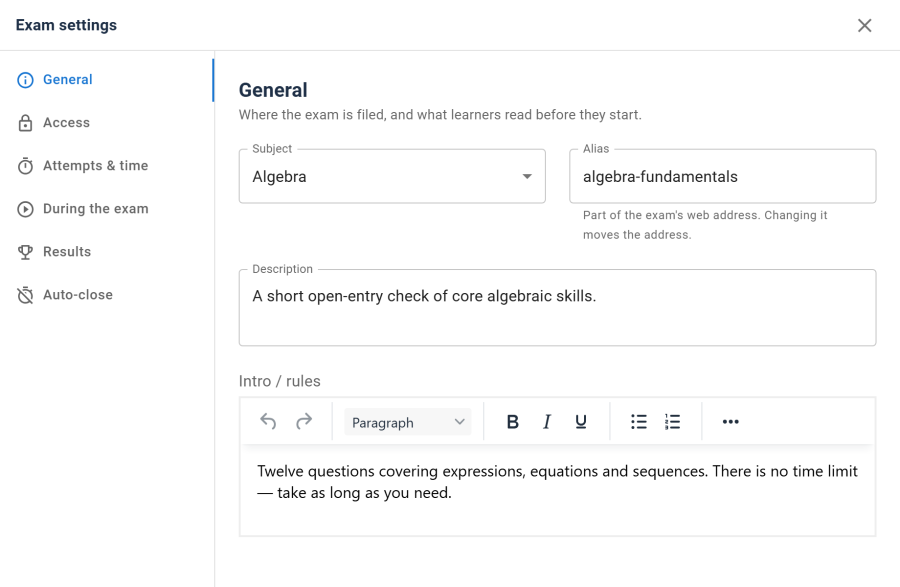
Everything below this point lives under Exam settings in the top bar, which slides in over the studio without leaving it. It has six panels:
| Panel | What it holds |
|---|---|
| General | Subject, alias (the exam's web address, see SEF URLs and SEO), description and the introduction learners read first |
| Access | Who may take the exam, and when it is open |
| Attempts & time | Time limit, attempt cap, cooldown, exam or practice mode, pause and resume |
| During the exam | Layout, shuffling, review before submitting, finishing early, fullscreen, integrity signals |
| Results | Pass mark, result release, what a learner sees and receives afterwards |
| Auto-close | What happens to an attempt the learner walks away from |
Shuffling
Two independent switches:
| Setting | Effect |
|---|---|
| Shuffle questions | Randomises the order questions are presented in |
| Shuffle options | Randomises the order of the options within a choice question |
Both are resolved when the attempt starts and frozen with the paper, so an examinee who reloads sees the same order they had before — shuffling is not re-rolled on every page load.
A question can keep its own options in order while the exam shuffles everything else: switch off Shuffle options in that question's settings (useful for "All of the above" or a scale from low to high). That choice is frozen with the paper too. Ordering and matching questions are always shuffled, whatever either switch says, because in their authored order they would give the answer away.
Timing and attempts
| Field | What it does | Notes |
|---|---|---|
| Time limit | Minutes allowed for the attempt | Enforced on the server. Reaching zero auto-submits. |
| Maximum attempts | How many times one person may sit the exam | Practice attempts are excluded. |
| Cooldown | Minutes that must pass between attempts | Checked at start, next to the attempt cap. |
| Open from / Open until | The window during which the exam can be started | Absolute times. See When the exam window shuts, below. |
Taking mode
The Attempts & time and During the exam panels of the exam settings. Four behaviours, set per exam, each with a global default that seeds new exams.
| Setting | Options | What changes |
|---|---|---|
| Attempt mode | Exam or practice | Practice ignores the time limit, the attempt cap and the cooldown, and never auto-locks. |
| Practice reveal | On submit, or per question | Per-question reveal grades and locks one answer at a time and shows feedback immediately. |
| Layout | Single page, or one per page | One-per-page pages through the questions client-side over a server-rendered form. |
| Pause and resume | Allowed or not, with caps | Freezes the clock. Both the number of pauses and total paused minutes can be capped; zero means unlimited. |
The chosen mode is frozen into the attempt at start, so changing the exam does not alter how a running attempt behaves.
Exam runner
Three more settings, in the During the exam panel, decide how the runner presents itself, and are frozen into the attempt the same way.
| Setting | Options | What changes |
|---|---|---|
| Review answers before submitting | On or off | Adds a final step listing every question as answered, not answered or flagged, so nothing is handed in blank by accident. On by default. |
| Allow finishing early | On or off | Puts a Finish action in the runner header, reachable from any question. With it off, finishing is only offered on the last question. On by default. |
| Fullscreen | Off · Offered · Expected | Offered adds a fullscreen button. Expected also asks at the start and again if the examinee leaves. Off by default. |
Fullscreen is best-effort and never blocks an attempt: Safari on iPhone and iPad cannot grant it, and neither can many LMS embeds, so those examinees continue in a distraction-free view. Leaving fullscreen is recorded as an integrity signal and nothing more. See Exam Runner.
Auto-close abandoned attempts
An examinee who closes the browser mid-exam never tells the server anything. Without a rule to close it, that attempt stays in progress indefinitely: it keeps holding one of the learner's allowed attempts, and the answers they had already saved are never marked. These settings decide what happens instead. Each is per exam, with a global default under Settings → Taking that seeds new exams.
Three situations close an attempt:
- The time limit runs out. Applies to timed exams only.
- Nothing is heard for the inactivity period. This is the only rule that reaches an untimed exam or a paused attempt — neither has a deadline that can pass, so without an inactivity period they would stay open forever.
- The exam window shuts, if the exam is set to stop everyone at that moment.
| Setting | Options | What it does |
|---|---|---|
| When an attempt is closed automatically | Hand it in and mark it · Void it | Marking uses whatever was already saved. Voiding records no result and gives the learner their attempt back. |
| Close after inactivity | Minutes, 0 to disable | Measured from the last contact with the examinee's browser. |
| When the exam window shuts | Stop every attempt · Let each run its own clock out | Stopping is the usual choice for an invigilated sitting. Running out is kinder to someone who started late. |
| Tell the examinee | Say it was closed automatically · Send the usual submission email · Send nothing | The first option uses a dedicated email template that explains why it closed. |
| Time spent on a closed attempt | Cap at the deadline · True wall clock | Capping keeps duration statistics honest: a one-hour exam closed a week later still reads as one hour. |
| Also close attempts an invigilator paused | Yes / No | Off by default. A room frozen deliberately — for a fire alarm, say — should not submit itself while everyone is outside. |
Notes worth knowing:
- Attempts started near the closing time do not outlive it. When the exam is set to stop everyone at the window, the deadline is capped at the closing time when the attempt starts, so the countdown the examinee sees is truthful. Pausing and resuming cannot be used to push past it.
- Grading is never skipped. Marking a closed attempt runs the normal grading path, including partial credit, so a result closed automatically is indistinguishable from one handed in by hand.
- Webhooks and LMS grade passback always fire, whichever notification option you choose — an external gradebook stays correct regardless of what the learner is told.
- Closures are recorded in the live monitoring activity log, attributed to Automatic.
Access and release
The Access panel of the exam settings decides who may sit the exam, and the Results panel what they see afterwards.
| Field | What it does |
|---|---|
| Access type | View level, open registration, access code, identified guest, or restricted to an allow-list. Covered in full under Access gates. |
| Access code | The shared code, when the access type requires one. |
| Result release | Immediate, after the exam closes, at a scheduled time, or manual. |
| Release at | The absolute time, for scheduled release. |
| Show answers | Whether the correct answers are revealed alongside the score. A separate decision from releasing the score itself. |
| Pass message / Fail message | Rich text shown on the result page under the pass or fail banner. Inherits the release gating, so it is not shown before results are released. |
| Certificate template | Which certificate to issue on a pass. None by default. |
| Lock policy | Whether the attempt's review locks after being seen. |
| Pass mark | The percentage needed to pass, and the threshold certificates are issued against. |
Integrity and monitoring
Two per-exam switches connect the exam to the observation features:
- Track integrity enables focus-loss, paste, tab-switch and fullscreen-exit capture for this exam. It is frozen into the attempt at start, and also requires the global capture switch. See Integrity signals.
- Live monitoring needs no per-exam switch — any in-progress attempt appears on the board. See Live monitoring.
Custom fields
If custom fields are defined for the exam context, they appear in the exam settings alongside the native fields. Searchable fields are stored so they can be filtered on; the rest are stored with the exam. See Question Bank for how the two storage modes differ.
Access control
| Action | Required permission |
|---|---|
| View exams | exams — view |
| Create an exam | exams — create |
| Edit an exam | exams — edit |
| Delete an exam | exams — delete |
| Publish or unpublish | exams — publish. Without it, saving keeps the exam's current state and a new exam starts unpublished. |
| Write or edit a question inside the exam | Also needs questions — create / edit |
| Edit, unpublish or delete an exam-only question | questions — the matching action and exams — edit. It is part of that exam, wherever it is opened from. |
| Preview | exams — view |
| Build a restricted access rule | Also needs cohorts — view, to choose a cohort |
The exam detail view additionally shows a performance card drawn from analytics; it is only populated for users who also hold reports view permission, and is simply omitted otherwise rather than erroring.